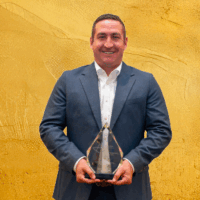








ACAMS Today recently caught up with Gabriel Vedrenne, who is the senior reporter covering Europe for ACAMSmoneylaundering.com. Prior to joining ACAMS, he spent a decade in Paris, France, as a business journalist and managing editor. After joining ACAMS in 2019, he spent nearly six years in London before moving back to France last autumn. Vedrenne covers the development of anti-money laundering (AML) laws and compliance procedures as well as law enforcement’s (LE) operations in Europe, with a specific focus on French and German-speaking countries such as France, Germany, Switzerland, Belgium, Luxembourg, Austria and Monaco. He also monitors developments at financial institutions in other neighboring European countries. A data enthusiast, he especially enjoys writing data-driven stories enhanced with charts.
ACAMS Today (AT): What drew you to work for ACAMS and specifically ACAMSmoneylaundering.com?
Gabriel Vedrenne (GV): I had just arrived in London after a decade in Paris and was looking for a new professional challenge. I came across a job offer that seemed to tick all the boxes: solid experience in journalism, knowledge of economics and finance, an interest in anti-financial crime (AFC) and fluency in French or German. It was the perfect combination for me.
AT: Can you describe a typical day in your role as senior reporter for ACAMS moneylaundering.com?
GV: First and foremost, a double espresso. Then I catch up on everything that has been published from the previous day, by the media, public authorities and social media. I compile a daily press review that I distribute internally, which serves as the backbone for our midweek and weekly roundup.
After that, my days are extremely unpredictable. I read reports, studies and enforcement notices published by public authorities in the countries I cover, looking for new developments in the types of financial crime or in the way supervisors and LE agencies are tackling them. Sometimes there is enough to start a straight news story, sometimes there are just a few interesting details that I set aside and which, once complemented by other information, can become an article.
I spend a great deal of time writing and talking to sources to verify pieces of information, better understand certain topics, get feedback from the field, test ideas or simply get an analysis or a comment. Conferences, events and meetings with authorities are also an important part of the work to keep up-to-date and meet people.
Then, of course, there is the writing, which is based on interviews and collected data that I send to my editor for review. The process entails my editor sometimes asking for clarification and challenging how certain information is formulated until we arrive at a final draft, which will be reviewed again by the entire editorial team before final publication. Journalism isn’t just a reporter on his own with a notebook and a voice recorder; it involves collaboration and collective intelligence, critical thinking, etc. It is a team effort.
AT: You have said that you tend to take a data-led approach to your articles. Can you describe what that entails and how you incorporate data into your news stories?
GV: I collect the figures I come across daily to feed into my Excel spreadsheets and track developments in supervision, enforcement actions and reporting activity―trying to look beyond the national scope to get the bigger picture at the European level.
It is a laborious task that does not always bear fruit immediately but it does so in within three to six months. For example, a fine imposed on a car-leasing company in one country does not mean much by itself, but when we realize that, at the same time, supervisors in neighboring countries are doing the same thing, it reveals a shift in the authorities’ focus toward a subsector and this is not always communicated.
It also makes it possible to clarify vague statements. An example would be when a financial intelligence unit (FIU) mentions the need to improve communication with prosecutors on the financial crime cases they refer to without providing further details. Collecting data on judicial referrals and feedback from prosecutors over several years shows that the latter have fallen and that there is a serious problem, but if we stick to the authorities’ very diplomatic wording we may miss this.
Once the data has been collected, analyzed and the results confirmed during interviews with specialists, I move on to data visualization to transform data into clear charts. A good chart can save many paragraphs of text. It also allows us to share our content on social media and beyond. I have already seen some of my charts on staff shortage among FIUs appear during debates on AML in the European Parliament. This demonstrates the power of data visualization, which allows people to grasp issues quickly.
AT: Are there any particular AFC topics you enjoy writing about?
GV: New typologies are, in my opinion, the most interesting aspect because they demonstrate the inventiveness and responsiveness of criminals. The slightest reform or structural change creates blind spots, and it is often criminals who identify and exploit them first.
In the same vein, I like to follow technological innovations because they also offer new opportunities for financial crime and force the compliance community to anticipate indirect effects. Virtual international bank account numbers (vIBANs) are a good illustration of this and have kept us busy over the last two years. These vIBANs enable money launderers and fraudsters to have an account in one country but obtain a virtual account number in another country, making it possible to conceal the country where the account is actually located. This results in FIUs wasting a lot of time investigating. The vIBANs are also quite convenient for conducting scams. At the moment, I am particularly interested in the digital euro and the European Central Bank’s promise that it will offer the same level of confidentiality as cash for small transactions. This obviously raises numerous questions in terms of AML.
AT: What recent financial crime trends have you noticed developing in Europe?
GV: As elsewhere, artificial intelligence (AI) is changing the game, giving criminals access to new tools and enabling them to industrialize their activities, as seen in the wave of fraud and scams. The most cunning fraudsters managed to automate the submission of public aid applications during the COVID-19 pandemic; by the time the authorities noticed, it was too late. Some have also managed to take advantage of AI to create false identities and open bank accounts, giving us an idea of what lies ahead.
Paradoxically, we are also seeing a return to simpler methods used to avoid the financial sector and its increasingly sophisticated detection capabilities. Underground banking seems to be experiencing a resurgence in Europe and is increasingly high on the authorities’ agenda.
AT: What do you like to do in your spare time?
GV: I used to watch a lot of movies, documentaries and series, but that’s not really the case anymore. Having young children, I spend a lot of time with them and my partner because this time is precious. So, on weekends we often go to playgrounds, take walks in the forest and build cities with Lego or Duplo, depending on their ages.
As a Frenchman, I also attach great importance to food and spend a lot of time cooking. I often do this while listening to podcasts, another one of my hobbies. I mainly listen to programs on international relations, economics and crime.
And coming from the Marseille region, I follow my football (soccer!) club, Olympique de Marseille (OM), closely and try to go to the stadium once a year, one of the loudest and most passionate venues in Europe. I’m also a basketball fan, especially the San Antonio Spurs, but going to see a game is a bit more complicated.
Interviewed by: Ben Bahner, editor, ACAMS Today, bbahner@acams.org