







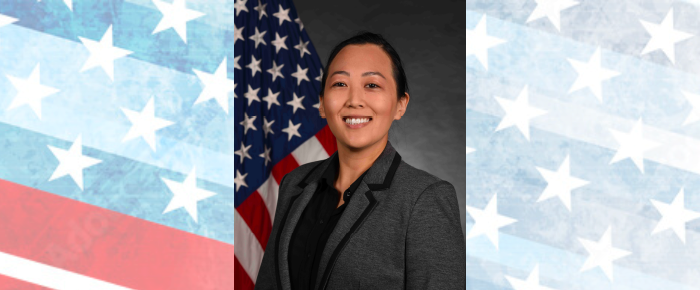
ACAMS Today sat down with Jessica Sunkamaneevongse, a fraud/anti-money laundering (AML) investigator and an international affairs enthusiast, with active top secret/sensitive compartmented information clearance. She is an accomplished federal leader with a decade of experience in leading cross-functional teams at the intersection of complex investigations, international relations and strategic planning.
Sunkamaneevongse is a critical problem-solver who thrives in fast-paced environments. She has established impactful relationships with key stakeholders, senior government leaders and international organizations. In addition, she has the proven capacity to turn failed units and programs into award-winning teams. Based out of the Washington, D.C, area, Sunkamaneevongse speaks English, Thai and Japanese.
ACAMS Today (AT): What drew you to pursue a career as a service member?
Jessica Sunkamaneevongse (JS): It’s a tale as old as time: I’m a first-generation Thai American who truly wanted to give back to my country. When I was younger, I knew I wanted a career rooted in service and giving back to local communities. Certainly, I recognize that a career in service can be attained in various industries―not all are inherently tied to military service. It ultimately was my freshman year of college when a friend introduced me to the Reserve Officer Training Corp (ROTC) program, and my desire to serve in the military took off from there. Fortunately, I was able to serve as a Special Agent with the Air Force Office of Special Investigations for the entirely of my military career. Thus, from personal security details for senior U.S. officials―including the president and vice president of the U.S.―to protecting the integrity of the Air Force Academy enterprise, I was able to fully fulfill my “Service Before Self” dream. I’m now ready for the next chapter in life, and I’m confident my experiences will help me excel in the anti-financial crime (AFC) field!
AT: You speak multiple languages. How many do you speak and how has being fluent in different languages helped your military career?
JS: I am ethnically Thai; Thai is my native tongue, and I speak it fluently. One of my proudest moments―although also sobering―was helping translate for a victim of sexual assault. Likewise, I was also able to explain the woman’s internalization of Thai culture and norms to the investigators, who questioned why she stayed with her husband despite all the abuse and trauma. At the end of the interview, the woman told me she appreciated me being there and felt strong enough to finally tell her story. As for Japanese, I studied the language for over eight years, starting in high school and ultimately majoring in it for my undergrad. Unfortunately, I’m nowhere nearly as fluent as I used to be, although I am still able to communicate at a basic conversational level. Nevertheless, when I was stationed in Japan between 2020-2022, I leveraged my language skills to bridge conversational gaps in meetings with the Tokyo Metropolitan Police Department. Similarly, my cultural understanding gained through prior lived experiences in Japan in 2008 helped drive and inform my team’s ability to foster deeper relationships with Japanese military and police.
AT: What type of fraud schemes caught your attention while you were investigating for the military? Can you also share what skills you think are important for investigating fraud?
JS: When I first started my career, the majority of my time in investigations had been primarily counterintelligence investigations―national security-level crimes with the FBI. So the first time I heard of all these varied fraud schemes was still at the start of my career and had to do with romance scams, such as if a young junior airman were to be approached by an attractive, beautiful or handsome individual on the social media platforms. Back then―about a decade ago―Snapchat was a key tool that scammers would use because it enabled, for example, a nude photograph to be sent that would disappear almost immediately. These young military members would receive the photo and then, in exchange, they would submit money to these criminal actors. At that time, I approached the problem from a counterintelligence perspective for one of these junior military members. Were they involved in a classified work environment? Did they have secret or top-secret clearance? Did they work on platforms involving significant sensitive capabilities? I meshed that all together, which made me wonder why it was that these junior members were attracting so many romance scams compared to more executive, senior leaders in the military. This led me to the realization of their vulnerability due to the lack of education regarding romance scams and the lack of a full awareness of the access they have as military members and how that might be enticing to foreign intelligence actors who are trying to gain access to our critical and classified information. That was my first eye-opening experience with romance scams.
AT: In your military experience, did you have any cases where you have dealt with either human smuggling or human trafficking?
JS: One case that I ran in partnership with U.S. Customs and Border Protection (CBP) and brought to the attention of the Assistant United States Attorney was a migrant smuggling case. Essentially there was a military member who was new to the Air Force who was incentivized by a friend he met to smuggle Mexicans through the Arizona border into the U.S. for $2,000. It’s such a low monetary amount to risk his career, his livelihood and risk getting caught―which he did. He ended up getting caught by CBP in a full-on, high-speed chase. Running that investigation enlightened me to the importance of having a neutral mentality as you’re approaching investigations because every investigation should be afforded an objective point of view from the investigator, without adding your bias to it.
In addition, it is important to have effective interpersonal skills working with law enforcement officers from different agencies, because you don’t know necessarily what the internal culture is for different government, local police and state agencies.
AT: How has your investigative approach evolved since you first entered the military and are you incorporating new technologies such as AI?
JS: My understanding and appreciation for the importance of hard skills or technical skills has evolved. Certainly as an investigator, you need soft skills. But nowadays hard skills are extremely important in the data sciences. For example, for investigative analysis, you need to know certain software capabilities and tools to analyze criminal data trends to help inform someone like the chief of police of what the trends are in a certain neighborhood or part of town. I have also made it my goal to study more data science, learn more about structured query language or certain mechanisms that would enhance my investigative capabilities so that I can aggregate trends quicker and more effectively to help drive the course of the investigation and to better understand overall criminal trends as they evolve and emerge.
As for AI, as I was leaving my job with the Air Force Office of Special Investigations, there were talks about how to better integrate AI into our day-to-day investigative operations. Some examples of possible AI usage were leveraging AI to scan agent notes, police notes or documents to essentially save time and make work efficient, as well as using AI to transcribe voice recordings of an interview and summarize and publish investigation reports. The human element would still be necessary to review and evaluate these summaries, but it could save that person hours of sitting at the computer and typing it out themselves.
However, security is an important component related to the data we are feeding into the AI machine. Say the government sells a contract to Company A to create a security protocol to secure the back end of an AI software so that cyber actors can’t attack it and get access to personal information, such as interviews of victims and witnesses and subjects of a crime. But company A then tries to get the contract to a different company that is not as secure and no one’s informed that company A has done this. The next thing you know, all of this sensitive government information is leaked to the public or personally identifiable information is compromised, data gets into the wrong hands and Social Security numbers are now being sold on the blacklist.
AT: Did you want to add anything about leveraging your experience on how organizational cultures shape responses to financial crime risk?
JS: The important thing in organizational cultures is being able to effectively respond to financial crime risk―the people element. Also, this ties into my point about AI. AI is amazing, but you still need someone to regulate, train and monitor it so that it meets whatever degree of compliance exists right now for AI.
In addition, it is important to create an organizational culture focused on innovation, staying updated on current trends, current regulations and policies and sanctions that are affecting the AFC world. Once the organizational culture is focused on relevancy, innovation and critical thinking, it fosters a positive go-getter, self-starter environment where people are more likely to stay in tune to new developments that will help guide their investigations based on current typographies and trends versus working with an antiquated mentality.
AT: You are currently transitioning into the AFC profession, what would your ideal role encompass?
JS: My ideal role would start with putting in the hours to develop my credibility and reputation as a trusted AML and/or fraud investigator (manager). Eventually, I want to progress to senior leadership positions with greater supervisory responsibilities. I’m also interested in risk management/sanctions advisory roles. My entire military career had touchpoints with risk management and compliance. Even now in my current SkillBridge internship with the U.S. Department of State, I’m continually developing my risk management skills. I conduct risk analysis and compliance reviews daily as I draft policy recommendations on Foreign Military Sales/Financing and end-use agreements for the regional portfolios I oversee. Getting this strategic-level exposure is enlightening, and I’m seeking to complement the lessons learned with my professional background into either an investigator or risk management role.
AT: What was the turning point in your career that made you choose a new career path in the AFC industry?
JS: My most recent military assignment was as the fraud and corruption program manager at the Air Force Office of Special Investigations headquarters in Quantico, Virginia. In this role, I helped supervise a fraud investigative consultation team comprised of special agents, analysts and a representative to the Financial Crimes Enforcement Network. Our team streamlined communications with our regional departments and championed our company’s vision of strengthening the investigative fraud program. Within about six months, we noted a 57% increase in fraud case initiations compared to the prior year and received positive feedback from agents who relied on us for consultations. The work was rewarding and reinvigorating and sparked a deeper interest in the anti-fraud world. But it wasn’t until I connected with Nick Schumann, the U.S. head of Financial Crime Framework at HSBC, through the American Corporate Partners Veteran Mentoring Program that my knowledge of the AFC industry expanded. He explained to me the “art of what’s possible” and how I can leverage my experiences in counterintelligence and fraud investigations into an impactful career in AFC. Since our first meeting in March 2025, I’ve done extensive research and reading into all things AFC. I’m craving the opportunity to disrupt terrorist financial networks and help keep financial institutions in regulatory compliance.
AT: Having served in the armed forces, how do your acquired skills translate easily to the AFC field?
JS: Since I was 18, the Air Force ROTC instilled in me the concept of “Flexibility Is the Key to Airpower.” Simply put, the military taught me how to successfully adapt to changing workplace requirements and environments, while remaining resilient to adversities. Moreover, my decade with the Air Force Office of Special Investigations taught me how to lead cross-functional teams through complex investigations while keeping executives informed on emerging threats as to maintain stakeholder trust. Obviously, the landscape of the AFC world is constantly changing. Criminal actors are getting smarter at leveraging technological advancements―AI, I’m talking about you―to enhance their dirty biddings. I know I’m preaching to the choir that we must adapt to remain relevant. I’m eager to bring forth my self-starter and innovative mentality into crafting a meaningful AFC career. Whether it’s applying my interpersonal skills, effective communication, investigative background or ability to thrive in fast-paced environments, I know my skills will easily transfer to the AFC field.
AT: What do you enjoy doing when you are off the clock?
JS: I really enjoy going on long walks at the end of the workday to decompress and visit my neighborhood park that has a pond filled with turtles, geese and ducks. Also, being near nature is comforting to me. I’m also getting back into reading, and I recently finished Reggie Fils-Aimé’s “Disrupting the Game: From the Bronx to the Top of Nintendo.” His motto of “living life at the intersection of capability and opportunity” couldn’t ring truer. So, I’m definitely seizing this opportunity to reach a larger AFC network!
Interviewed by Karla Monterrosa-Yancey, CAMS, editor-in-chief, ACAMS, editor@acams.org,