







The ACAMS Assembly Las Vegas, held from September 23-25, 2024, at the Aria Resort and Casino, presented a variety of sessions addressing important anti-financial crime (AFC) topics such as cryptocurrency, compliance regulation, suspicious activity reports (SARs), artificial intelligence (AI) and generative AI (GenAI), the FTX scandal, online gaming, child trafficking and emerging developments in anti-money laundering (AML)/AFC. In addition, several ACAMS Awards were presented during a special ceremony at the event.
Welcome Remarks and Day One Sessions
The first day of The Assembly Las Vegas kicked off with remarks from Neil Sternthal, chief executive officer (CEO) of ACAMS. Sternthal reflected on several ACAMS initiatives, including filling the gap in the industry for anti-fraud training and certification programs; preparing the second ACAMS Global Threats Report; and offering scholarship opportunities to enhance the pool of AFC professionals.

ACAMS’s CEO Neil Sternthal delivered the opening remarks at The Assembly Las Vegas on September 23.
Sternthal finished by stating that attendees should take the information they learn at the Assembly and share it throughout the global AFC community. “What takes place in this Assembly can’t stay in Vegas,” he noted.
At the keynote address on Monday morning, Claudia Quiroz, director of the National Cryptocurrency Enforcement Team at the U.S. Department of Justice, touched on a common misconception regarding the victims of cryptocurrency-related crime. She observed, “The elderly are clearly being targeted. They are a vulnerable population, but only 30% of victims of these scams are over the age of 60. All demographics are targeted, but what we have seen is that the highest number of victims are between the ages of 30 and 49 and this is actually … the largest crypto user group.”
During a session that afternoon titled “Deep Dive—Secret Sauce for SARs: How Your Quality Team Can Help Improve Your Filings,” panelists discussed how quality teams could assist banks of every size to produce more actionable SARs. One of the panelists, Dandridge Myles, head of SAR management at TD Bank, said, “I always say that the SAR is the part of your AML program that leaves the bank. It goes to law enforcement [LE] and it goes to the regulators. Those are your customers. So, you want that SAR to be representative of your company, your organization. You want to make sure that when someone picks it up, they know what they’re going to get. It’s going to look the same. It’s going to sound the same and it’s going to hit all of the points that they want to see.”

Left to right: Moderator Megan Hodge of Ally with presenters Jane Bell of SAS, Deanna Boyd of PNC and Dandridge Myles of TD Bank at the "Deep Dive—Secret Sauce for SARs: How Your Quality Team Can Help Improve Your Filings” session on Monday afternoon.
Fellow panelist Deanna Boyd, vice president, AML and head of Quality at PNC, observed, “If you prioritize everything, you prioritize nothing…. Perfection is the enemy of productivity. You really do have to find a balance.”
ACAMS Awards Presented
Day two began with the presentation of several ACAMS Awards including the Life Achievement Award, which was given to AFC pioneer Dennis Lormel, president and CEO of DML Associates. In addition to recognizing Lormel’s 28-year-long career within the Federal Bureau of Investigation (FBI), Lormel was thanked for spearheading the bureau’s terrorist financing initiative post-9/11, which led to the formation of the Terrorist Financing Operations Section in the FBI. In his acceptance speech, Lormel urged Assembly attendees to pay it forward by becoming mentors. Erin West, deputy district attorney in Santa Clara County, California, and a leading cryptocurrency crime fighter and pig butchering scam expert, was honored with the ACAMS AFC Professional of the Year Award. The ACAMS Rising AFC Professional of the Year Award was presented to Dr. Alice Tregunna, who currently serves as the compliance and financial crime lead at Ernst & Young in Bermuda. Jonathan Dupont, a subject-matter expert on cryptocurrency, human trafficking and crimes against children based in Lithuania, received the ACAMS Today Article of the Year Award for the article “Pig Butchering: The ‘Super Scam’.” In addition, the ACAMS Australasia Chapter was named ACAMS Chapter of the Year, while Markus Schulz was honored for his contributions as the ACAMS Advisory Board Chair from 2021-2024.
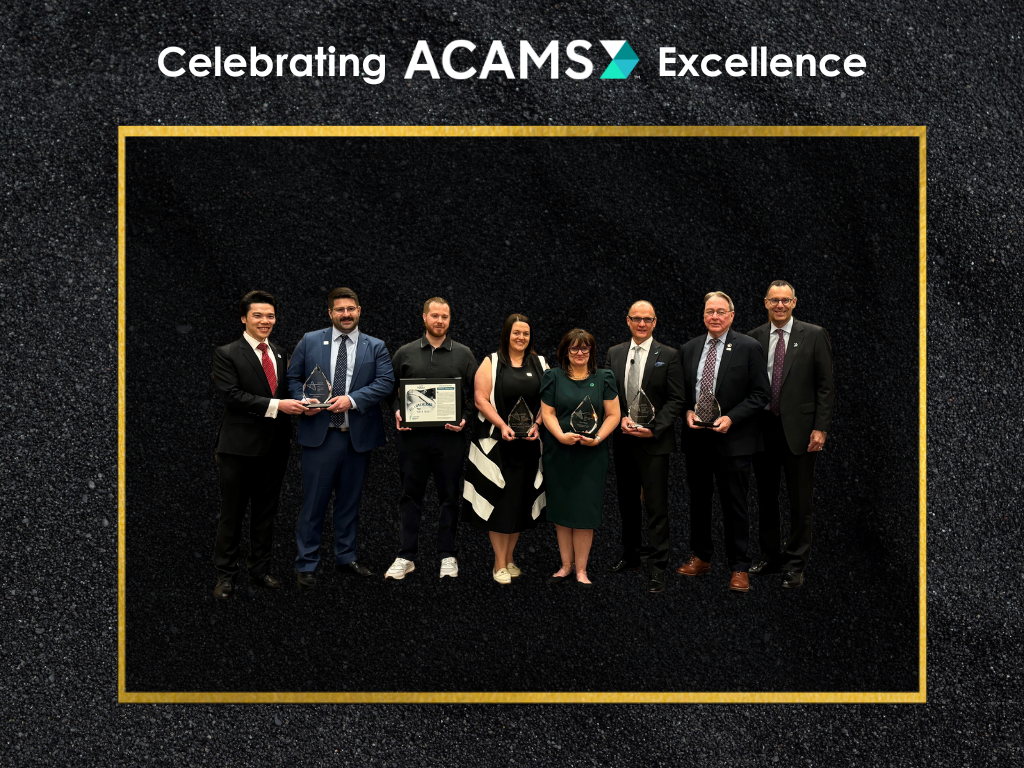
Pictured left to right are ACAMS Award winners Crispin Yuen and Martin Dilly on behalf of the ACAMS Australasia Chapter, Jonathan Dupont, Dr. Alice Tregunna, Erin West, Markus Schulz and Dennis Lormel, with ACAMS’ CEO Neil Sternthal.
GenAI, the Collapse of FTX and More
The awards ceremony was followed by the panel discussion, “This Is Big: Compliance Implications of Generative AI,” which highlighted the possible uses of large language models and GenAI by institutions, regulators, examiners and auditors. During the session, Carrie Gilson, director of Financial Intelligence and Analytics and senior vice president at U.S. Bank, said, “We are at a tipping point. This is an incredible time to be not only in the financial crimes industry but from a technology perspective…. I equate it to the industrial revolution. Honestly, I don’t think that there’s been a time that so much change has occurred…. Human roles will change for the better.”
Tuesday’s keynote session focused on the failure of FTX and featured panelists Scott Hartman of the U.S. Attorney’s Office for the Southern District of New York and Steven D. Glik, supervisory special agent at the FBI. During the session, Hartman noted some uses for the funds that FTX misappropriated prior to its collapse: the purchase of real estate; donations to political candidates and charities; investment in third parties; and payments to lenders.
That afternoon, a session titled “ASK ME ANYTHING—The AI Advantage, Beyond Fraud: How Criminals Try to Think Like a Chief Technology Officer” took a look at topics including how criminals currently employ AI for their crimes, how they may use it in the future and the resulting challenges for LE and financial institutions. During the session, James C. Barnacle, deputy assistant director of the FBI’s Criminal Investigative Division, noted, “Most people who are victims of fraudulent AI do not know that they are victims of fraudulent AI.” He later observed, “In 2022, $47 billion in nongovernmental funding went into AI in the U.S. alone, and 18 out of the top 20 AI companies in the world are based in the U.S. That presents many challenges to the U.S., primarily from nation-state actors.”

Left to right: Moderator Joby Carpenter of ACAMS with panelists James C. Barnacle of the FBI, Ana Davila of Stripe and Aditya Mehta of WorkFusion at the “ASK ME ANYTHING—The AI Advantage, Beyond Fraud: How Criminals Try to Think Like a Chief Technology Officer” session.
During the “What Financial Institutions Need to Know About Online Gaming—and Vice Versa” session Tuesday afternoon, panelist Jonathan Fishner of FanDuel remarked, “There is a legal argument out floating around there somewhere that the BSA does not apply to online gaming companies. But I’m not aware of a reputable legal operator in the United States that is not acting as if the BSA does apply…. We are thinking about the pillars of an AML program all the time.”
Child Trafficking, Breaking Developments in AFC/AML Discussed on Final Day
On the final day of The Assembly Las Vegas, ACAMS Chief Operating Officer (COO) Mariah Gause moderated a special presentation titled “Together Against Exploitation—Insights from a Survivor and Federal Government,” featuring speakers Brandi N. Bynum, acting unit chief of the U.S. Department of Homeland Security, Center for Countering Human Trafficking, and child trafficking survivor Jerome Elam, president and CEO of the Trafficking in America Task Force.

Left to right: ACAMS COO Mariah Gause, Jerome Elam of the Trafficking in America Task Force and Brandi N. Bynum of U.S. Department of Homeland Security’s Center for Countering Human Trafficking.
Bynum, who oversees the Blue Campaign human trafficking (HT) public awareness program, defined HT as “the use of three elements—force, fraud or coercion—to obtain some type of labor or commercial act.” If the victim is under 18 and involved in a commercial act, it is immediately considered to be HT. For victims over the age of 18, the U.S. Department of Justice needs to prove force, fraud or coercion to have it considered HT, she said.
Elam of the Trafficking in America Task Force, added, “The CDC did a study of victims of trafficking and abuse they saw in one year and tracked them over their lifetimes. The lifetime cost for these victims was $124 billion. That’s health care, incarceration … rehabilitation. We’re really doing ourselves a disservice morally, spiritually and financially by not addressing this crime more aggressively.”
The three-day Assembly closed with “Breaking News: ACAMS MLDC Presents the Latest Developments in AML/AFC,” a discussion of emerging trends and topics such as AFC regulation and the potential impact of the upcoming U.S. presidential elections. The session, led by moderator Kieran Beer, chief analyst and director of editorial content for ACAMS, featured panelists William J. Fox, formerly of Bank of America; Young Lee of the U.S. Department of the Treasury; Elizabeth Rosenberg of Bank of America; and Melissa Strait of Coinbase.
When asked about his prediction for the future, Fox, who recently retired from the roles of managing director and global head of Financial Crimes Risk at Bank of America, replied, “I will guarantee that everybody who works in an … anti-financial crimes or sanctions function will be spending their time on risk assessment.”
Beer closed the conference program by thanking the panelists, the audience (both in-person and virtual) and the ACAMS Events team for putting the conference program together before announcing that The Assembly Las Vegas will take place next year from September 15-17 at the same venue.
Reported by the ACAMS Today Editorial Staff
Karla Monterrosa-Yancey, CAMS, editor-in-chief, kmonterrosa@acams.org
Ben Bahner, CAMS, editor, bbahner@acams.org
Monica Mendez, CAMS, senior international editor
Ana Cecilia Martinez, CAMS, associate editor, ana.martinez@acams.org